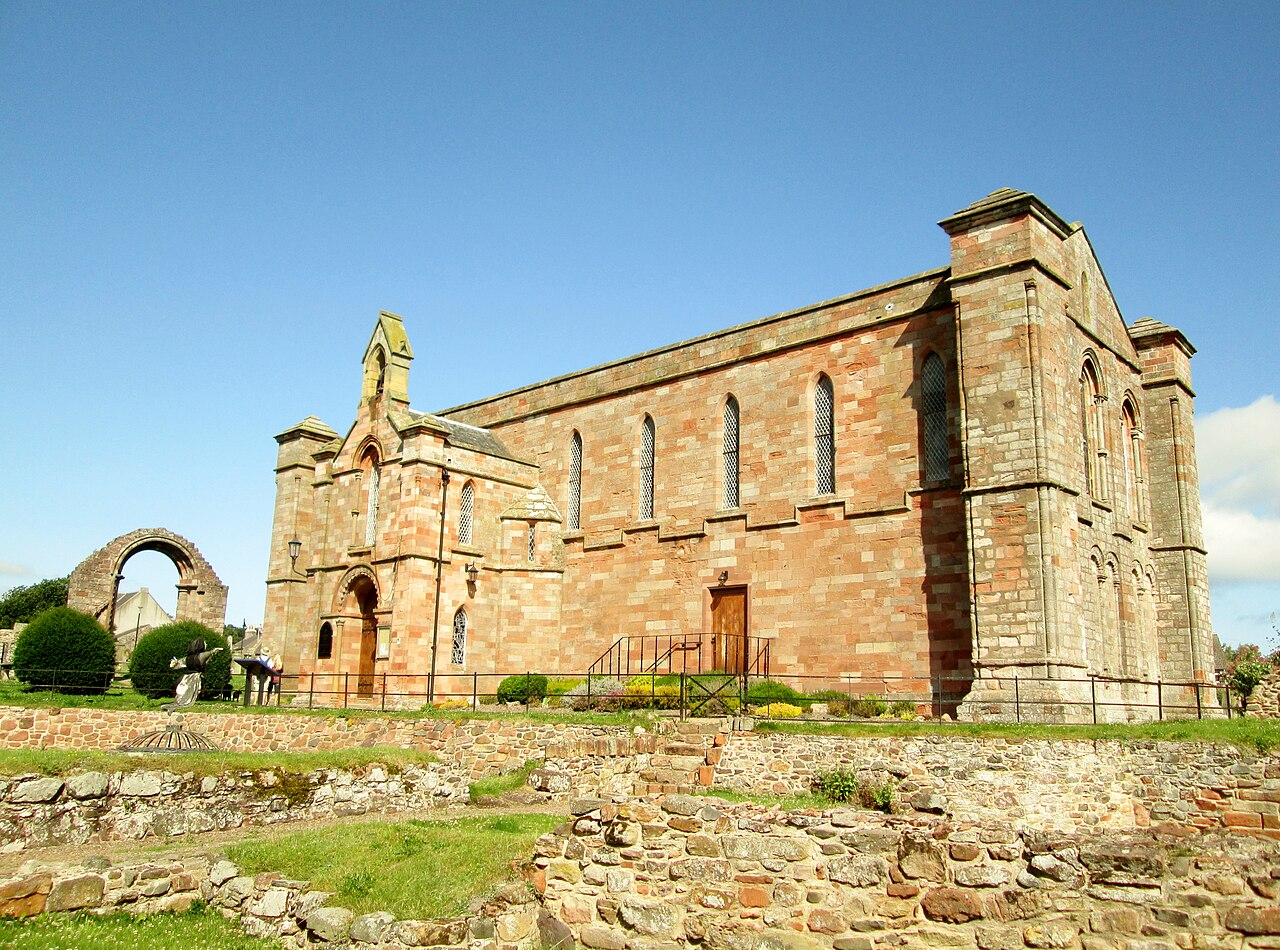
Coldingham Priory Church and priory remains. Photograph: Martin Dawes / Wikimedia Commons, CC BY-SA 2.0.

The present parish church occupies the medieval priory choir, combining Romanesque and Gothic fabric with rebuilding after war, fire, collapse and Victorian restoration.
Quick facts
- Date
- Medieval fabric from the eleventh and thirteenth centuries; remodelled 1662 and 1851–1855
- Architect / designer
- Medieval and later builders; individual designers not securely identified
- Type
- Parish church incorporating the choir of a medieval Benedictine priory
- Designation
- Listed building, Category A (LB4059)
- OS grid reference
- NT 90394 65949
Architecture and continuing use
Coursed pink and red sandstone forms a rectangular church with corner towers, blind arcading, chevron ornament and pointed lancets. The north and east walls retain thirteenth-century priory fabric. A south porch, bellcote and stair tower belong to the composite later building, while a graveyard and former hearse house frame the approach.
Its story
King Edgar granted Coldingham to Durham’s Benedictines in 1098 and a first church was consecrated in 1100. A larger cruciform priory followed destruction in 1216. Damage in 1648 led to the choir’s adaptation for worship in 1662; fire in 1745 and tower collapse around 1770 caused further loss. Restoration in 1851–55 produced much of the present form.
Why it is included
It is the architectural and historical centre of Coldingham, linking a nationally important medieval monastery with continuing worship.
What to notice
- Chevron-decorated blind arcades and engaged colonnettes.
- Medieval north and east wall fabric beside nineteenth-century rebuilding.
- The relationship between church, graveyard and separate scheduled remains.
Reading the surroundings
Respect worship, events and burials. Follow current parish information and managed paths; the adjoining scheduled archaeology has separate protection.
Timeline
- 1098–1100 Royal grant and consecration established the Benedictine church at Coldingham.
- 13th century A larger cruciform priory supplied fabric retained in the present choir.
- 1662 Rebuilding made the damaged choir usable for parish worship.
- 1851–1855 A major restoration renewed walls, roof, fittings and entrance arrangements.
What we know — and what remains uncertain
Repeated rebuilding makes the exact age of individual stones difficult to establish without specialist fabric analysis.
Sources & further reading
- Historic Environment Scotland: Coldingham Priory Church, LB4059 — Current designation status, statutory identity, official mapped point, date, fabric and significance.
- Coldingham Parish: Priory Church resources — Current parish evidence for worship, community use and visitor resources at the Priory Church.
- Trove: Coldingham Priory Church — National collection entry corroborating the designation identity, mapped location and related archive material.
- National Library of Scotland: georeferenced historic maps — Historic-map comparison for the building, street pattern and surrounding settlement; map dates and layers should be checked individually.
Location
OS grid reference NT 90394 65949 · Location confidence: High for the current HES designation point; public text separately qualifies component extent, terrain and access. · Select the marker to open its satellite view in Google Maps. On desktop, drag Pegman (the yellow figure) onto a blue road. On mobile, turn on the Street View layer and tap a blue road. Other photo markers may be user-contributed.
Suggest a marker correction
Suggest a more accurate position
The teal marker is the current published position. The orange marker starts slightly to its right so both remain visible; this is only a visual starting position. Tap the correct place on the map or drag the orange marker. Sending this form creates a private review entry only; it does not move the published marker.
Check this area in Google Maps Choose the Satellite layer there if useful.
Map: © OpenStreetMap contributors. You can also enter checked coordinates below.