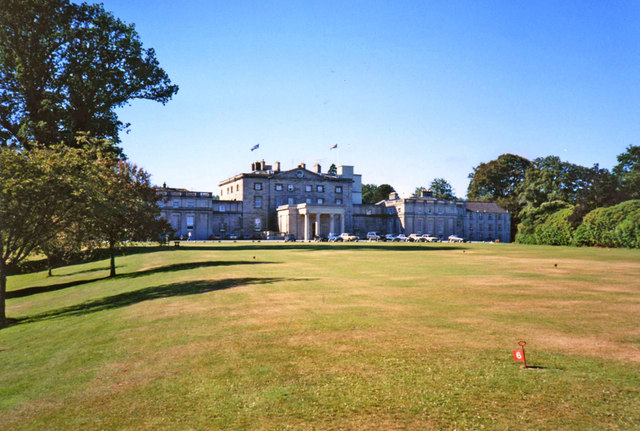
Image: Cally Palace by Christine Matthews, sourced from Wikimedia Commons and licensed under CC BY-SA 2.0.

Robert Mylne’s great classical house remains the architectural focus of the Cally estate while serving as a hotel and golf resort.
Quick facts
- Date
- 1763–1765; altered 1795 and 1833–1837
- Architect / designer
- Robert Mylne; Thomas Boyd; John Buonarotti Papworth
- Type
- Classical country house adapted as a hotel
- Designation
- Listed building, Category A (LB9854)
- OS grid reference
- NX 59982 54946
Architecture, archaeology and continuing use
A pedimented three-storey centre is linked by lower corridors to flanking pavilions. Polished granite, red-sandstone architraves, bowed rooms and Papworth’s massive Doric porch give the long composition both local material character and metropolitan ambition.
Its story
James Murray commissioned the house after meeting the young Robert Mylne in Rome. Later campaigns raised the wings, reshaped the principal interiors and added the portico; the estate house entered hotel use in the 1930s.
Why it is included
Category A status, major architectural authorship and a direct role in the creation of Gatehouse make Cally essential to the Place launch.
What to notice
- Pedimented centre with an oculus.
- Massive monolithic Doric columns at the porch.
- Long corridor links between the main block and pavilions.
Reading the surroundings
This is an operating hotel and golf resort. Enter public customer areas only as a guest or visitor and follow the hotel’s arrangements for the house, grounds, parking and course.
Timeline
- 1763–1765 Robert Mylne completed the principal house for James Murray.
- 1795 Thomas Boyd raised the wings and introduced linking corridors.
- 1833–1837 Papworth remodelled the interiors and added the granite portico.
- 1934 The former country house began its modern hotel chapter.
What we know — and what remains uncertain
Later hotel additions changed the wings substantially, but the principal eighteenth- and nineteenth-century rooms remain legible.
Sources & further reading
- Historic Environment Scotland: Cally Palace, LB9854 — Designation status, mapped location, date, fabric and architectural or archaeological interest.
- Cally Palace Hotel — Current hotel, golf, dining and guest use with public contact information.
- Historic Environment Scotland: Cally designed landscape — Estate development, Murray ownership, landscaping and conversion of the house to hotel use.
Location
OS grid reference NX 59982 54946 · Location confidence: High: the national designation supplies an official mapped National Grid Reference; the independent source confirms the Place relationship, history or current identity. · Select the marker to open its satellite view in Google Maps. On desktop, drag Pegman (the yellow figure) onto a blue road. On mobile, turn on the Street View layer and tap a blue road. Other photo markers may be user-contributed.
Suggest a marker correction
Suggest a more accurate position
The teal marker is the current published position. The orange marker starts slightly to its right so both remain visible; this is only a visual starting position. Tap the correct place on the map or drag the orange marker. Sending this form creates a private review entry only; it does not move the published marker.
Check this area in Google Maps Choose the Satellite layer there if useful.
Map: © OpenStreetMap contributors. You can also enter checked coordinates below.