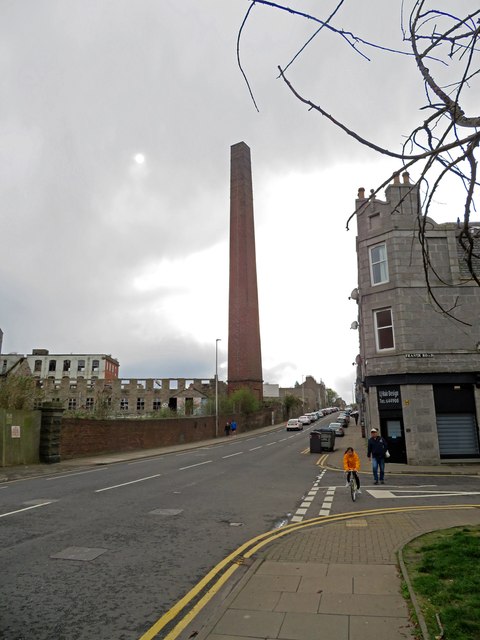
Image: Broadford Works by Chris Allen, 13 April 2025, sourced from Wikimedia Commons and licensed under CC BY-SA 2.0.

A vast former textile works preserves the scale and internal street pattern of Aberdeen’s early mechanised industry while awaiting a viable new use.
Quick facts
- Date
- Established 1808; enlarged through the nineteenth century and 1904–1914
- Architect / designer
- Fenton, Murray and Wood; later in-house engineers and Wilsons and Walker
- Type
- Extensive former textile works of mills, warehouses, offices and setted internal streets
- Designation
- Listed building, Category A (LB43908)
- OS grid reference
- NJ 93560 06922
Architecture and continuing use
Granite- and brick-clad mills rise around setted lanes, combining early iron framing with later reinforced concrete. Repeated windows, tall spinning blocks, warehouses, offices and a bowed porter’s lodge form an industrial townscape rather than a single building.
Its story
John Maberly established the works in 1808, and later owners expanded flax, wool and textile production. Twentieth-century closure left a nationally important but vulnerable complex; successive plans have sought housing and mixed uses while retaining key buildings.
Why it is included
Category A designation, exceptional industrial scale and unresolved conservation risk make Broadford Works a necessary record of both achievement and vulnerability.
What to notice
- Setted internal streets between mill ranges.
- Changing granite, brick, iron and concrete construction.
- Scale of the spinning blocks and relationship with the entrance lodge.
Reading the surroundings
Do not enter the site. View only from public streets, observe barriers and active works, and treat derelict structures as dangerous.
Timeline
- Established 1808 John Maberly established the works in 1808, and later owners expanded flax, wool and textile production. Twentieth-century closure left a nationally important but vulnerable complex; successive plans have sought housing and mixed uses while retaining key buildings.
- Present Long-disused industrial complex allocated for residential-led mixed-use regeneration; surviving fabric is not a public attraction.
What we know — and what remains uncertain
Planning allocations and permissions do not guarantee delivery. The record therefore describes an allocated regeneration site, not a completed development.
Sources & further reading
- Historic Environment Scotland: Broadford Works, LB43908 — Designation status, mapped location, construction phases, fabric, authorship and architectural or historical interest.
- Ryden: Broadford Works project — Professional project summary for residential-led mixed-use regeneration of the historic mill site.
Location
OS grid reference NJ 93560 06922 · Location confidence: High: the statutory designation supplies an official mapped National Grid Reference and the current source confirms the Place relationship or present identity. · Select the marker to open its satellite view in Google Maps. On desktop, drag Pegman (the yellow figure) onto a blue road. On mobile, turn on the Street View layer and tap a blue road. Other photo markers may be user-contributed.
Suggest a marker correction
Suggest a more accurate position
The teal marker is the current published position. The orange marker starts slightly to its right so both remain visible; this is only a visual starting position. Tap the correct place on the map or drag the orange marker. Sending this form creates a private review entry only; it does not move the published marker.
Check this area in Google Maps Choose the Satellite layer there if useful.
Map: © OpenStreetMap contributors. You can also enter checked coordinates below.