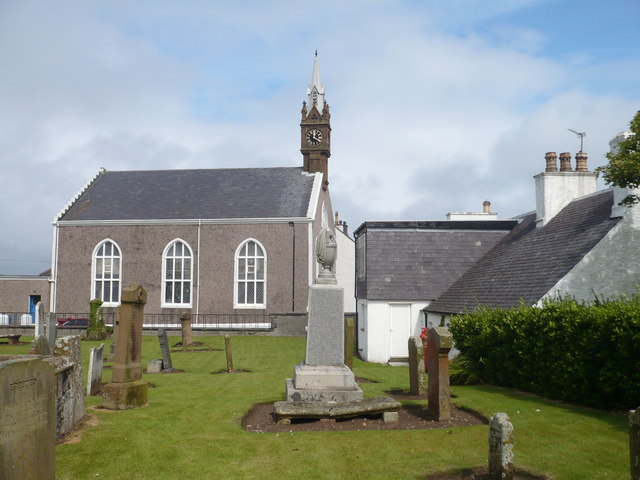


At Ballantrae Parish Church two stairs lead from the small entrance vestibule up to the gallery. The steep roof and stepped gables belong to the church of 1819. The clock tower was added in 1891.
Quick facts
- Date
- 1819; clock tower added 1891
- Architect / designer
- Original designer unrecorded
- Type
- Post-Reformation parish church with later clock tower
- Designation
- Listed building, Category B (LB871)
- OS grid reference
- NX 08366 82485
- Later alteration
- Rear vestry enlarged 1961
Architecture and history
The church is a simple harled worship building whose regular openings and clear massing suit a large rural congregation. Its later tower and clock provide the most prominent public accent, while the interior retains a notably well-crafted pulpit.
The congregation’s building history describes seating for roughly 350 and a Regency pulpit. The gallery could be reached from either side of the entrance without crossing the main seating area. The vestry at the rear was enlarged in 1961.
Its story
The congregation transferred here from the older church whose Kennedy aisle survives in the adjoining burial ground. Victorian work added the clock tower, and the building continues to support worship and parish activity with St Colmon.
What to notice
- The contrast between the plain 1819 body and later tower.
- The clock faces added to serve the wider village.
- The surviving pulpit and simple congregational interior when legitimately open.
Location and Photos
The church stands at the junction of Main Street and The Vennel in Ballantrae.
Timeline
- 1819 The present church opened and replaced the older parish building.
- 1891 A clock tower transformed the kirk into a more conspicuous village landmark.
- 1971 The building entered the national list at Category B.
Sources & further reading
- Historic Environment Scotland: Ballantrae Parish Church, LB871 — Designation status, mapped location, date, fabric and architectural or archaeological interest.
- Ballantrae Parish Church — Current congregational identity, worship use and service information.
- Scotland’s Churches Trust: Ballantrae Parish Church — Independent description of the 1819 church, 1891 tower and surviving pulpit.
- Ballantrae Parish Church, parish profile, pp. 12–13 — Interior layout, gallery stairs and capacity, Regency pulpit, 1961 vestry extension and the identities behind three memorial windows.
Location
OS grid reference NX 08366 82485 · Location confidence: High: the national designation supplies an official mapped National Grid Reference; the independent source confirms the Place relationship, history or current identity. · Select the marker to open its satellite view in Google Maps. On desktop, drag Pegman (the yellow figure) onto a blue road. On mobile, turn on the Street View layer and tap a blue road. Other photo markers may be user-contributed.
Suggest a marker correction
Suggest a more accurate position
The teal marker is the current published position. The orange marker starts slightly to its right so both remain visible; this is only a visual starting position. Tap the correct place on the map or drag the orange marker. Sending this form creates a private review entry only; it does not move the published marker.
Check this area in Google Maps Choose the Satellite layer there if useful.
Map: © OpenStreetMap contributors. You can also enter checked coordinates below.